You’ve been staring at the same three options for twenty minutes. Maybe you searched “nausea wristband” from the bathroom at work, or from bed at 5am before the alarm, or from an airport lounge hoping something would arrive before your flight. And every search returns the same names, the same stock photos, the same vague promises about acupressure and “natural relief.”
None of them tell you what you actually need to know: which one works, which one is comfortable enough to wear all day, and which one won’t make you look like you’re recovering from a hospital visit.
That’s what this page is for. No affiliate rankings. No sponsored placements. An honest comparison of the major acupressure-based nausea wristbands available right now, evaluated on the things that matter when you’re the one wearing it: how the pressure is applied, what it’s made of, how long you can wear it comfortably, and what it actually looks like on your wrist.
How Acupressure Wristbands Work
Every acupressure wristband targets the same anatomical site: the P6 acupressure point, also called Neiguan, located on the inner wrist approximately three finger-widths below the wrist crease, between two tendons. P6 stimulation has been studied in over forty clinical trials across pregnancy-related nausea, post-operative nausea, chemotherapy-induced nausea, and motion sickness. The evidence base is substantial and growing.
The mechanism is straightforward. Sustained pressure at P6 modulates signaling along the vagus nerve, which runs from the brainstem through the chest and into the abdomen. This nerve is a key mediator of the nausea response. Acupressure at this site has been practiced for over two thousand years in traditional Chinese medicine, and the modern clinical research largely confirms what practitioners have long observed.
But here’s the part that doesn’t get discussed: how the pressure is applied matters. In clinical research, P6 acupressure is typically performed with the flat pad of the thumb or two to three fingers — broad, steady, distributed pressure across the zone. The contact area of a thumb pad on skin is approximately 150–250mm². The contact area of a small plastic bead — the component used by most wristbands — is approximately 15–25mm². That’s a tenfold reduction in stimulation surface.
This distinction shapes the comparison that follows.
Sea-Band: The Original
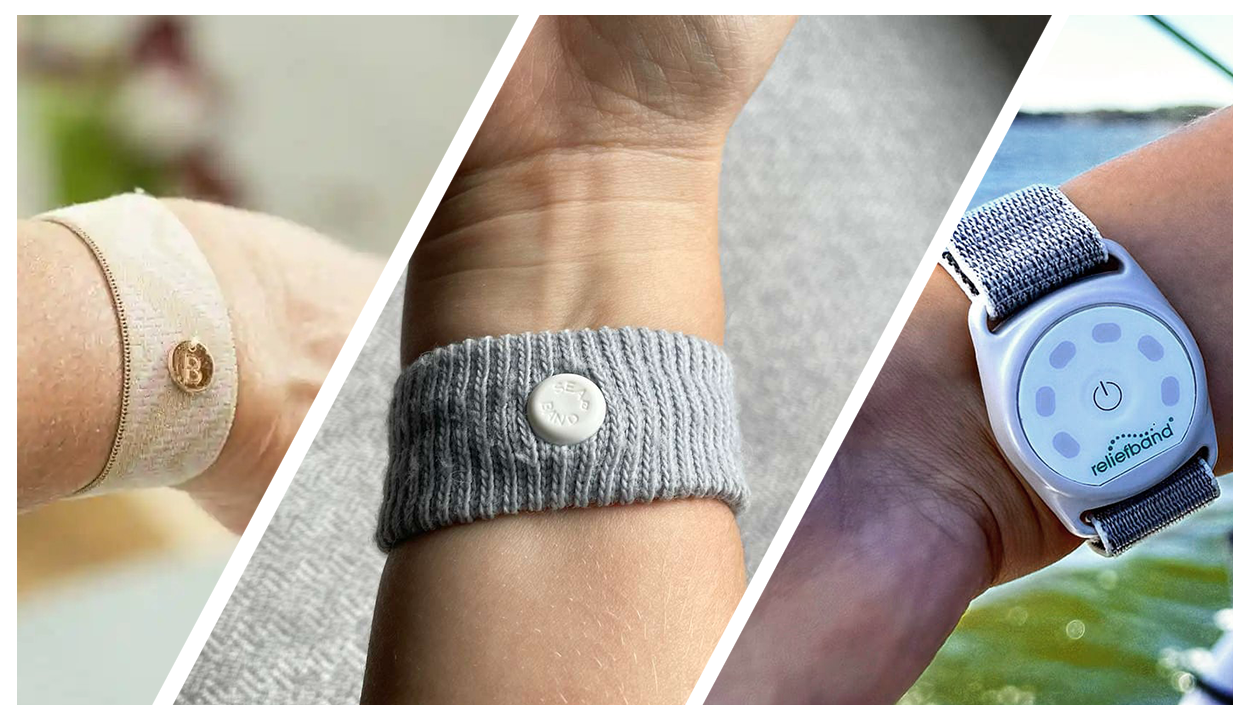
Sea-Band is the name most people encounter first. It’s been on the market for decades, sold in pharmacies worldwide, and priced at roughly $8–12. The product is a knitted elastic wristband with a small plastic bead sewn into the inner surface. You position the bead over P6, and the elastic holds it in place.
The advantages are real: it’s affordable, widely available, drug-free, and backed by the general evidence base for P6 acupressure. For someone who wants to try acupressure for the first time with minimal financial commitment, Sea-Band is the low-risk entry point.
The limitations show up in extended wear. The plastic bead is spherical, roughly 6mm in diameter. It concentrates all of the band’s pressure at a single apex point. Over time — and this is consistent across thousands of consumer reviews — that concentrated pressure creates discomfort: numbness, tingling in the fingers, and a visible indentation on the wrist.
Many users report needing to reposition the band frequently, or removing it after one to two hours because the pressure becomes uncomfortable.
This isn’t an acupressure problem. It’s a geometry problem. The P6 point sits directly over the median nerve pathway. A concentrated point-load on that nerve, applied for hours, creates compression symptoms. The bead is doing what a bead does — concentrating force at its apex. The question is whether that’s the best way to deliver pressure to this particular point.
The other limitation is aesthetic, and it matters more than it might seem. Sea-Band is a gray or beige elastic band. It looks medical. For someone managing nausea privately — a first-trimester pregnancy she hasn’t announced, a GLP-1 medication she hasn’t discussed at work — wearing a visibly medical band on her wrist answers a question nobody asked.
Reliefband: The Electronic Option
Reliefband takes a fundamentally different approach. Instead of passive pressure, it delivers mild electronic pulses to the underside of the wrist. It’s FDA-cleared as a medical device for nausea and vomiting, and it’s priced accordingly: $150–250 depending on the model.
The technology is called neuromodulation, and the clinical evidence supporting it is real.
Reliefband has invested in this category more seriously than any other brand from a research standpoint. If you want the most clinically substantiated electronic approach to nausea management, this is it.
The trade-offs are worth understanding. The device requires charging. It produces a tingling sensation on the wrist that some users find uncomfortable or distracting. The intensity settings require adjustment, and finding the right level can take time. It’s a visible piece of technology on the wrist — less so than Sea-Band, but still identifiably a device, not a piece of jewellery. And the price point is significant, particularly for someone who isn’t certain acupressure or neuromodulation will work for her specific situation.
The mechanism is also worth distinguishing clearly: Reliefband is not acupressure. It uses electrical stimulation, which is a different intervention with its own evidence base.
Comparing it directly to an acupressure band is comparing two different approaches to the same problem. For a feature-by-feature breakdown of all three products, see our Reliefband vs Sea-Band vs Blisslets comparison.
Blisslets: The Aesthetic Alternative
Blisslets entered the market with a straightforward proposition: an acupressure wristband that doesn’t look like a medical device. The bands are designed to resemble bracelets, available in several colors and finishes, and marketed primarily to women experiencing motion sickness and morning sickness.
The positioning is smart. It addressed the aesthetic gap that Sea-Band ignored. Women who wanted acupressure relief without the gray elastic band finally had an option that considered how they looked and felt wearing it.
Under the design, however, the pressure mechanism is identical to Sea-Band: a small plastic bead, roughly the same size and shape, positioned over P6. The differentiation is entirely in the band material and appearance. The pressure delivery — the part that determines whether the product actually works as acupressure — is unchanged.
This means Blisslets carries the same mechanical limitations: concentrated point-pressure at the bead apex, potential for discomfort over extended wear, and the requirement for precise placement of a small pressure point over P6. Users who experienced numbness with Sea-Band are likely to experience it with Blisslets as well, because the component creating that problem is the same.
Blisslets is priced at $20–30, placing it in the middle of the market. For someone who prioritizes appearance over Sea-Band but isn’t ready for Reliefband’s price point, it fills a real gap.
What the Comparison Reveals
When you line up these products, a pattern emerges. Two of the three use the exact same pressure applicator — a stock plastic bead. Their differentiation is in band material and branding. The third uses an entirely different technology (electronic stimulation) at a significantly higher price point.
What’s missing from the category is a product that has reconsidered the pressure applicator itself. The bead is the part that touches your skin. It’s the part that determines the pressure profile, the contact area, the comfort over extended wear, and the tolerance for imprecise placement. And across the two major acupressure brands, it’s the one component that has never been redesigned.
The clinical research on P6 acupressure was largely conducted with broad, distributed pressure — thumbs, fingertips, blunt rounded instruments. The pressure profile of a thumb pad is fundamentally different from the pressure profile of a 6mm plastic sphere. A wider, flatter contact surface would distribute force more evenly, reduce peak pressure over the median nerve, and capture a broader zone around P6 — reducing the precision required from the user.
Do Pressure Point Wristbands Really Work?
This is the question behind every comparison search, and it deserves a direct answer. (For a deeper dive into the clinical evidence, see our guide on whether anti-nausea wristbands actually work.) The P6 acupressure point has been studied in over forty peer-reviewed clinical trials. The evidence is strongest for pregnancy-related nausea and post-operative nausea, with meaningful evidence also supporting its use for motion sickness and chemotherapy-induced nausea. The consensus across systematic reviews is that P6 stimulation produces a statistically significant reduction in nausea compared to placebo.
That said, acupressure is not a guarantee. Individual responses vary. And the delivery method matters: the evidence was generated primarily through manual pressure application, not through wristband-based delivery. This is why how a wristband applies pressure — not just whether it targets P6 — is a relevant factor in choosing one.
Can I Wear Nausea Bands All Day?
Most manufacturers say yes, but the experience varies. The limiting factor is comfort, and comfort is determined by the pressure profile. A concentrated point-load from a spherical bead becomes increasingly uncomfortable over time because peak pressure at the apex increases as tissue around it compresses. Many users report a practical wear window of one to three hours before they need to remove or reposition the band.
A wider contact surface distributes force more evenly, reducing peak pressure at any single point. This is the engineering principle behind extended-wear comfort in acupressure: broader contact, gentler gradient, sustained pressure without escalating discomfort.
Making the Right Choice
The right wristband depends on what matters most to you. If price is the primary concern and you want to test whether acupressure works for your situation, Sea-Band is the lowest-risk entry point. If you want electronic stimulation with clinical evidence behind it and the price point isn’t a barrier, Reliefband offers a different approach entirely. If aesthetics matter and you want something that looks less medical, Blisslets improves on Sea-Band’s design while using the same pressure mechanism.
And if you’re looking for something that reconsiders how acupressure pressure is actually applied — broader contact, distributed force, a design that reflects the clinical methodology — that’s a category that’s only just beginning to be addressed.