There is a single point on the inner wrist that has been used to calm nausea for over two thousand years. It has been studied in more than forty peer-reviewed clinical trials. It has been applied by practitioners, tested by researchers, and used by millions of people who simply press their thumb into the right spot when their stomach turns.
It is called P6. Or Neiguan. Or Pericardium 6. The name depends on whether you are reading a traditional Chinese medicine text, a clinical research paper, or an acupressure guide. The point is the same.
What follows is everything worth knowing about it: where it is, why it works, what the evidence actually says, and how the modern products that target it do — and don’t — replicate the pressure that makes it effective.
Where Is the P6 Point?
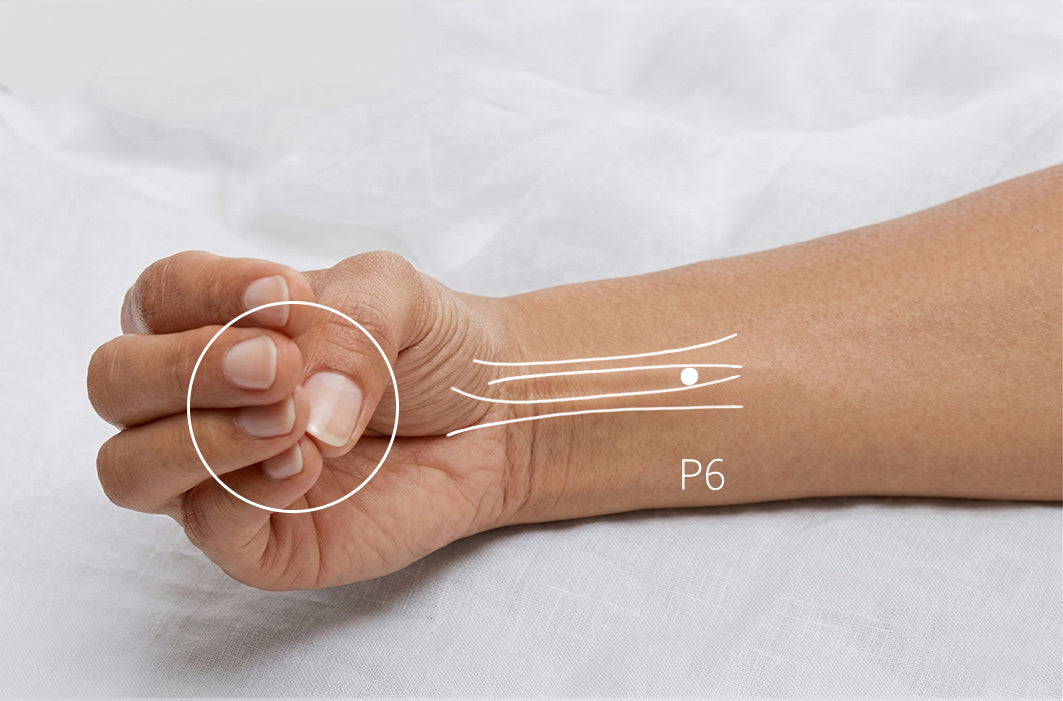
Place three fingers across the inside of your wrist, starting from the crease where your hand meets your forearm. The P6 point is directly below your index finger, between the two tendons you can feel when you flex your wrist.
Those two tendons are the palmaris longus and the flexor carpi radialis. P6 sits in the valley between them, over the pathway of the median nerve. In anatomical terms, it is approximately 4–5cm proximal to the distal wrist crease, which is why “three finger-widths” is the traditional measurement — it adjusts naturally for different hand sizes.
You can find it right now. Press your thumb firmly into that spot. If you feel a deep, slightly achy pressure — not sharp, not superficial — you’ve found it. That sensation is the hallmark of an acupressure point being correctly stimulated. In traditional Chinese medicine, it is called “de qi” — the arrival of therapeutic pressure.
What Does P6 Acupressure Do?
P6 sits directly over the median nerve, which communicates with the vagus nerve — the longest cranial nerve in the body, running from the brainstem through the chest and into the abdomen. The vagus nerve plays a central role in the nausea response, mediating signals between the gut and the brain.
When sustained pressure is applied at P6, it modulates vagal nerve activity. The prevailing hypothesis, supported by both traditional understanding and modern neuroimaging research, is that P6 stimulation interrupts or dampens the neural signaling cascade that produces the sensation of nausea. It does not suppress the signal entirely — it moderates it.
This is why P6 acupressure is described as “relief” rather than “cure.” It reduces the intensity and frequency of nausea episodes. For many users, that reduction is the difference between a functional day and a canceled one. For a broader look at how acupressure fits into a full nausea management strategy, see our complete guide to acupressure for nausea.
What the Clinical Evidence Says
The research base for P6 acupressure is unusually robust for a non-pharmaceutical intervention. Over forty peer-reviewed trials have examined its effects, and several systematic reviews and meta-analyses have synthesised the findings.
The strongest evidence exists for pregnancy-related nausea. Multiple randomized controlled trials have demonstrated statistically significant reductions in nausea frequency and severity compared to placebo, with no adverse effects to mother or baby. This is particularly significant because the first trimester — when nausea is worst — is also when medication options are most limited.
Post-operative nausea and vomiting (PONV) is the second most-studied application. Trials have shown that P6 stimulation before and after surgery reduces the incidence of PONV, with the Cochrane Collaboration’s systematic review concluding that it is a viable non-pharmacological adjunct.
For chemotherapy-induced nausea, the evidence is meaningful though not as extensive (see our dedicated chemotherapy nausea management guide).
Several trials have shown P6 acupressure provides additional relief when used alongside standard antiemetic medication — not as a replacement, but as a complement that addresses the residual nausea that pharmaceuticals alone may not fully control.
Motion sickness research is smaller in volume but consistent in direction. P6 stimulation reduces self-reported nausea in controlled motion sickness environments, though the effect size varies across studies.
For medication-induced nausea — including the nausea associated with GLP-1 receptor agonists like semaglutide and tirzepatide — direct clinical trials are limited because GLP-1 nausea is a relatively new phenomenon at scale. However, the mechanism of nausea relief through P6 is not specific to nausea’s cause; it targets the downstream neural pathway. This is why the same intervention has been shown to work across such diverse triggers.
How Acupressure Is Actually Applied
In every traditional acupressure protocol, and in the majority of clinical research trials, the intervention is the same: broad, sustained, distributed pressure applied by a thumb pad or fingertips across the P6 zone.
The operative word is distributed. A thumb pad contacts approximately 150–250mm² of skin surface. The pressure is firm but not sharp. There is a gentle central gradient — slightly more pressure at the center of the thumb pad, tapering toward the edges — but the force is spread across the entire contact area. This is the pressure profile that produced the clinical evidence.
When tools are used in acupressure — historically and in contemporary practice — they share this quality: blunt, rounded, wide contact surfaces. Jade rollers, wooden dowels with rounded tips, the practitioner’s knuckle. The common feature is a broad, curved surface that distributes force. None approximate a small, hard sphere.
For centuries, the body has known what to do with pressure carefully applied.
How Wristbands Translate This
Modern acupressure wristbands attempt to automate what a thumb or practitioner’s hand does: hold sustained pressure at P6 throughout the day without requiring the user to press her own wrist.
The standard approach, used by every major acupressure wristband on the market, is a small spherical plastic bead positioned against the skin. The bead is approximately 6mm in diameter. Its contact area is roughly 15–25mm² — about one-tenth the contact area of a thumb pad.
This difference is not trivial. A spherical bead concentrates all of the band’s force at a single apex point. As the band’s tension holds the bead against the skin, peak pressure at the apex increases while the surrounding tissue receives minimal stimulation. This is a fundamentally different pressure profile from what generated the clinical evidence.
The consequences show up in three ways. First, the effective stimulation zone is narrow — the user must position the bead with millimetre precision over P6, because the contact area provides almost no margin for error. Second, peak pressure at the apex is high, which creates discomfort and numbness over extended wear as the median nerve is compressed beneath a concentrated point-load. Third, the pressure profile doesn’t replicate the broad, graduated pressure of traditional acupressure — the very methodology that produced the evidence base these products cite.
A flattened, wider pressure surface — one designed to mimic the thumb’s contact geometry — would address all three of these issues. Broader contact zone, distributed force, and a gentler pressure gradient that sits closer to what the research actually tested. That’s not a theoretical improvement. It’s a design correction.
The Five Forbidden Acupressure Points
If you’ve searched for acupressure information, you’ve likely encountered warnings about “forbidden” points. This refers to acupressure points that should be avoided during pregnancy due to their association with uterine stimulation. The points most commonly cited are SP6 (Spleen 6, on the inner ankle), LI4 (Large Intestine 4, between thumb and index finger), BL60 and BL67 (on the foot), and GB21 (on the shoulder).
P6 is not among them. It is considered safe across all populations, including pregnant women, which is precisely why it has been so extensively studied in pregnancy-related nausea trials. If you are pregnant and considering acupressure for nausea, P6 is the evidence-backed, practitioner-recommended point.
Can P6 Stop Vomiting?
P6 acupressure is more effective at reducing nausea than at stopping active vomiting. The evidence shows significant effects on nausea frequency and severity, with more modest effects on vomiting episodes specifically. If you are experiencing active vomiting, P6 pressure can be applied alongside other interventions, but it should not be expected to replace antiemetic medication in acute situations.
The greatest value of P6 acupressure is in managing the persistent, low-to-moderate nausea that characterizes many conditions: the daily queasiness of early pregnancy, the ongoing stomach discomfort of GLP-1 medication, the rolling nausea of motion sickness. This is the symptom profile where sustained, consistent pressure at P6 has the most documented effect. If you need relief right now, our guide on how to stop nausea fast covers the most effective immediate strategies.