You’re not here for a general overview. You’re here because you’ve narrowed it down to three options and you want someone to lay them side by side without the marketing language. Which one works. Which one is comfortable. Which one makes sense for your life.
We’ll go deep on each — mechanism, materials, what real users report after extended wear — and give you enough to make the call yourself.
The Fundamental Difference: Two Mechanisms, Not Three
Before comparing features, understand what you’re actually choosing between. Despite being grouped together as “nausea bands,” these products use two completely different approaches.
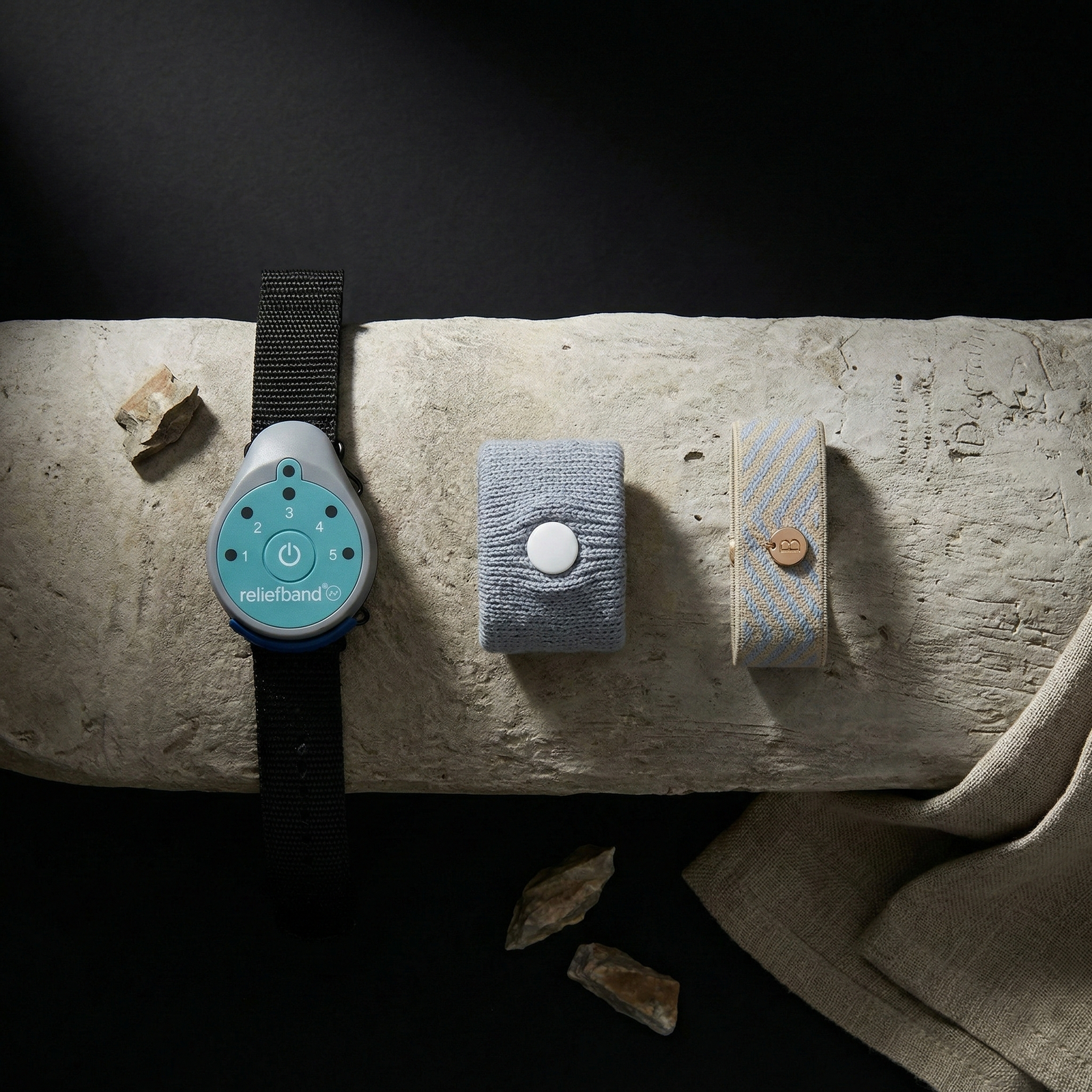
Sea-Band and Blisslets both use passive acupressure: a physical component presses on the P6 acupressure point on your inner wrist. The pressure is constant and requires no power source. The mechanism is the same one used in traditional P6 acupressure for over two thousand years and studied in dozens of clinical trials.
Reliefband uses transcutaneous electrical nerve stimulation (TENS). It sends mild electrical pulses through the skin to modulate nerve signaling. It requires charging, has intensity settings, and is FDA-cleared as a Class II medical device. The evidence base is separate from the acupressure evidence base.
This matters because if you’re choosing between acupressure and electrical stimulation, that’s a category decision, not a product decision. If you’ve already decided on acupressure — or you want drug-free relief without electronics, charging, or a tingling sensation — your real comparison is Sea-Band versus Blisslets, and the question becomes: is there a meaningful difference between them?
Sea-Band: A Closer Look
How It Works
A knitted elastic wristband with a small, spherical plastic bead positioned over the P6 point.
The elastic tension holds the bead against your skin. You wear one on each wrist for optimal effectiveness.
Materials and Build
The band is knitted acrylic/elastane. The bead is moulded plastic, approximately 6mm in diameter. The whole product weighs almost nothing and is machine washable. It’s designed to be disposable or semi-disposable — most users replace them after a few months of regular use.
What Users Report
The most consistent feedback pattern across thousands of reviews: it provides noticeable nausea relief for many users, but comfort deteriorates over time. The spherical bead creates a concentrated point of pressure that users frequently describe as uncomfortable after one to two hours. Numbness and tingling in the hand are common complaints. The band needs to be positioned precisely — if the bead shifts off P6 by even a few millimetres, effectiveness drops.
The aesthetic feedback is equally consistent: it looks medical. Users who need discretion — in professional settings, during early pregnancy, or while managing medication side effects privately — report feeling self-conscious wearing it.
Price
$8–12. The lowest entry point in the category.
Blisslets: A Closer Look
How It Works
The same mechanism as Sea-Band — a plastic bead positioned over P6 — housed in a more aesthetically considered band. The pressure delivery is functionally identical.
Materials and Build
The band is a flexible metal or fabric bracelet designed to look like jewellery rather than a medical device. The pressure component remains a stock plastic bead of similar dimensions to Sea-Band’s. The band itself is more durable and better looking than Sea-Band’s elastic.
What Users Report
Users appreciate the improved appearance. In terms of nausea relief, the experience mirrors Sea-Band because the pressure mechanism is the same. The comfort profile is also similar: concentrated point-pressure from the bead creates the same numbness and repositioning issues over extended wear. The band itself is more comfortable, but the bead — which is the part doing the therapeutic work — creates the same experience.
Price
$20–30. The mid-range option.
Reliefband: A Closer Look
How It Works
An electronic device worn on the underside of the wrist that delivers gentle electrical pulses.
You apply a conductivity gel, turn it on, and adjust the intensity level. The device stimulates nerves through the skin to reduce nausea signaling.
Materials and Build
A wearable tech device with a silicone or metal band, depending on the model. It requires regular charging (battery life varies by model, typically 12–24 hours). A small conductivity gel tube is included and needs periodic replacement.
What Users Report
Users report meaningful nausea reduction, often noting it works quickly when the right intensity level is found. The tingling sensation is the most polarising aspect — some find it reassuring (they can feel it working), while others find it uncomfortable or distracting. The need to carry and apply gel, charge the device, and adjust settings adds friction. Some users report skin irritation at the contact point after extended use.
Price
$150–250. The premium option.
The Head-to-Head
When you strip away the branding, the comparison resolves into one critical question: what touches your skin, and how does it deliver pressure?
Sea-Band and Blisslets use the same pressure applicator. A small, spherical plastic bead that concentrates force at its apex. The contact area is approximately 15–25mm². This is ten times smaller than the contact area of a human thumb pad, which is how acupressure has traditionally been applied and how most clinical trials delivered the intervention.
That gap between how acupressure was studied and how these products deliver it is the unaddressed issue in this category. (For a broader look at the market, see our roundup of the best anti-nausea wristbands in 2026.) The evidence for P6 acupressure is strong. The evidence was generated primarily with broad, distributed pressure. The products use narrow, concentrated pressure. These are different mechanical interventions applied to the same point.
Reliefband sidesteps this issue entirely by using a different mechanism. It’s not acupressure.
It’s neuromodulation. The trade-off is higher cost, battery dependence, gel, and the tingling sensation.
Is Sea-Band FDA Approved?
Sea-Band is registered with the FDA as a Class I medical device, which means it meets basic safety standards but does not require the clinical testing process that Class II devices like Reliefband undergo. This is a lower bar than “FDA approved” or “FDA cleared” as those terms are commonly understood. Blisslets is marketed as a wellness product, not a medical device.
Which One Should You Choose?
If you want the lowest-cost way to test whether P6 acupressure works for your situation, start with Sea-Band. The investment is minimal.
If you know acupressure works for you and appearance matters, Blisslets improves the visual experience while delivering the same pressure mechanism.
If you want electronic stimulation with the most clinical evidence behind it and the price and maintenance aren’t deterrents, Reliefband is a genuinely different approach.
If you still want to understand the science behind these products, read our article on whether anti-nausea wristbands actually work. If you’ve tried acupressure and found it helped with nausea but struggled with comfort, numbness, or the need to constantly reposition the band — the limiting factor may not be acupressure itself. It may be the geometry of a 6mm bead. A wider, flatter pressure surface that distributes force the way a thumb does would address each of those issues. That’s a category evolution that’s starting to emerge.