Nobody writes about this. The GLP-1 content landscape is all transformation photos and dosage discussions. The professional woman who travels for work and manages a medication that makes her unpredictably nauseous — she doesn't exist in that content. She exists here.
Injection Timing Around Travel
The single most impactful decision you make is when you inject relative to your travel days. Most GLP-1 medications are weekly injections, giving you flexibility in choosing your injection day. The general principle: inject two to three days before your heaviest travel or client-facing day. This allows the peak nausea window (typically 24–72 hours post-injection) to pass before you need to perform.
If you normally inject on Friday, and you have a Tuesday client dinner, keep your Friday schedule. If you inject on Wednesday and fly Thursday, consider shifting to Monday for travel weeks.
Discuss injection day flexibility with your prescriber. Most will confirm that shifting by one to two days within your weekly cycle is acceptable and won't affect efficacy.
Flying on a GLP-1
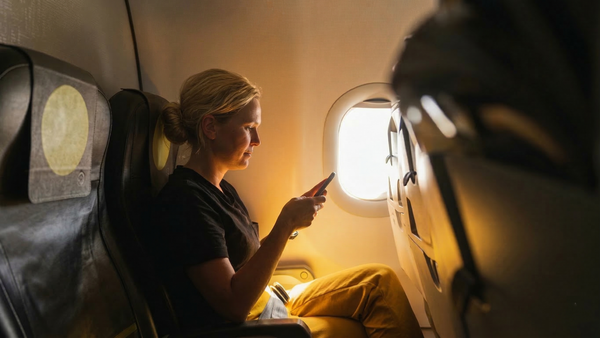
Air travel amplifies GLP-1 nausea for three reasons: altitude reduces oxygen levels (which can trigger nausea independently), the pressurized cabin dries you out (dehydration worsens nausea), and you're in a confined space with limited control over stimuli.
Pre-flight: eat a small, bland meal two hours before boarding. An empty stomach on a GLP-1 plus altitude is a reliable nausea trigger. Hydrate aggressively in the hours before your flight — more than you think you need.
In-flight: cold sparkling water is your best friend. Request it frequently. Avoid alcohol (it dehydrates and interacts poorly with GLP-1 nausea). Skip the in-flight meal unless you can identify something bland and protein-forward. An acupressure band on your wrist provides continuous P6 stimulation without requiring you to actively manage it.
Post-flight: give yourself thirty minutes of recovery before diving into work. A walk, fresh air, and rehydration reset your system more effectively than pushing through.
The Client Dinner
This is the scenario that generates the most anxiety. A meal you didn't choose, at a restaurant you can't control, with people who expect you to eat, drink, and be fully present.
Strategy one: eat something small and bland two hours before the dinner. This means you arrive with a settled stomach rather than an empty one, and you won't be ravenous (not that GLP-1 nausea usually allows that). A buffer meal gives you the flexibility to pick at the dinner menu without it being conspicuous.
Strategy two: order intentionally. Grilled proteins, simple preparations, plain sides. Avoid heavy sauces, fried foods, and rich desserts — not because they're unhealthy but because they're the most likely to trigger GLP-1 nausea. Most upscale restaurants accommodate specific preferences gracefully.
Strategy three: manage the alcohol expectation. "I'm on medication that doesn't mix well with alcohol" is factually true and professionally acceptable. Alternatively, order sparkling water with your meal from the start — it normalises not drinking without requiring an explanation.
Strategy four: maintain P6 acupressure throughout the evening. An acupressure band on your wrist is invisible at a dinner table and provides the continuous, subtle nausea management that lets you focus on the conversation rather than your stomach.
The goal isn't to feel nothing. The goal is to stay in the room — present, sharp, yourself.
Managing Nausea in Meetings
Meeting-room nausea on a GLP-1 follows the same principles as pregnancy nausea management: sit near the exit, keep cold water accessible, and maintain P6 pressure. The additional GLP-1-specific consideration is that stress and elevated cortisol can amplify nausea, so high-stakes meetings may trigger symptoms that normal workdays don't.
If you know a meeting will be intense, eat something small and bland thirty minutes before. Keep your snack discreet. Sparkling water in a meeting is unremarkable. And if you need a break, a brief "I need to take a call" exit is universally accepted.
Packing for GLP-1 Business Travel
Your medication in its original packaging with your prescription label. TSA and international equivalents do not typically question injectable medications, but the original box eliminates any ambiguity. Keep it in your carry-on, never checked luggage.
A small insulated pouch if your medication requires refrigeration (semaglutide pens are stable at room temperature for up to 56 days after first use; tirzepatide for up to 21 days). Check your specific medication's guidelines.
Your nausea management essentials: ginger chews, peppermint lozenges, an acupressure band, and a stash of bland snacks that travel well (protein bars, crackers, nuts). These go in your carry-on alongside the medication.
The goal of GLP-1 business travel isn't to eliminate nausea entirely — it's to manage it precisely enough that it never becomes the thing running the day. Injection timing gives you the macro control. Everything else — hydration, food strategy, P6 acupressure — is the micro control that keeps you present, sharp, and yourself.